X-Ray Diffraction: determine unit cell parameter $a$ and interplanar spacing $d$ from the diffraction peaks
engineering , materialsNote: This article contains mathematical notation rendered via KaTeX, which requires JavaScript. For better formatting and accessibility, a PDF version is provided here.
Context
X-ray diffraction is a technique used to determine the atomic or molecular structure of a crystalline material. It works by directing a beam of X-rays at a sample and measuring the angles and intensities of the diffracted beams (see Figure 1). The pattern of diffraction (see Figure 2) is unique to the crystal structure of the material, allowing researchers to infer the arrangement of atoms or molecules within the crystal lattice. XRD diffractometer; source: DrBoStefanov, Wikimedia Commons, CC BY-SA 4.0.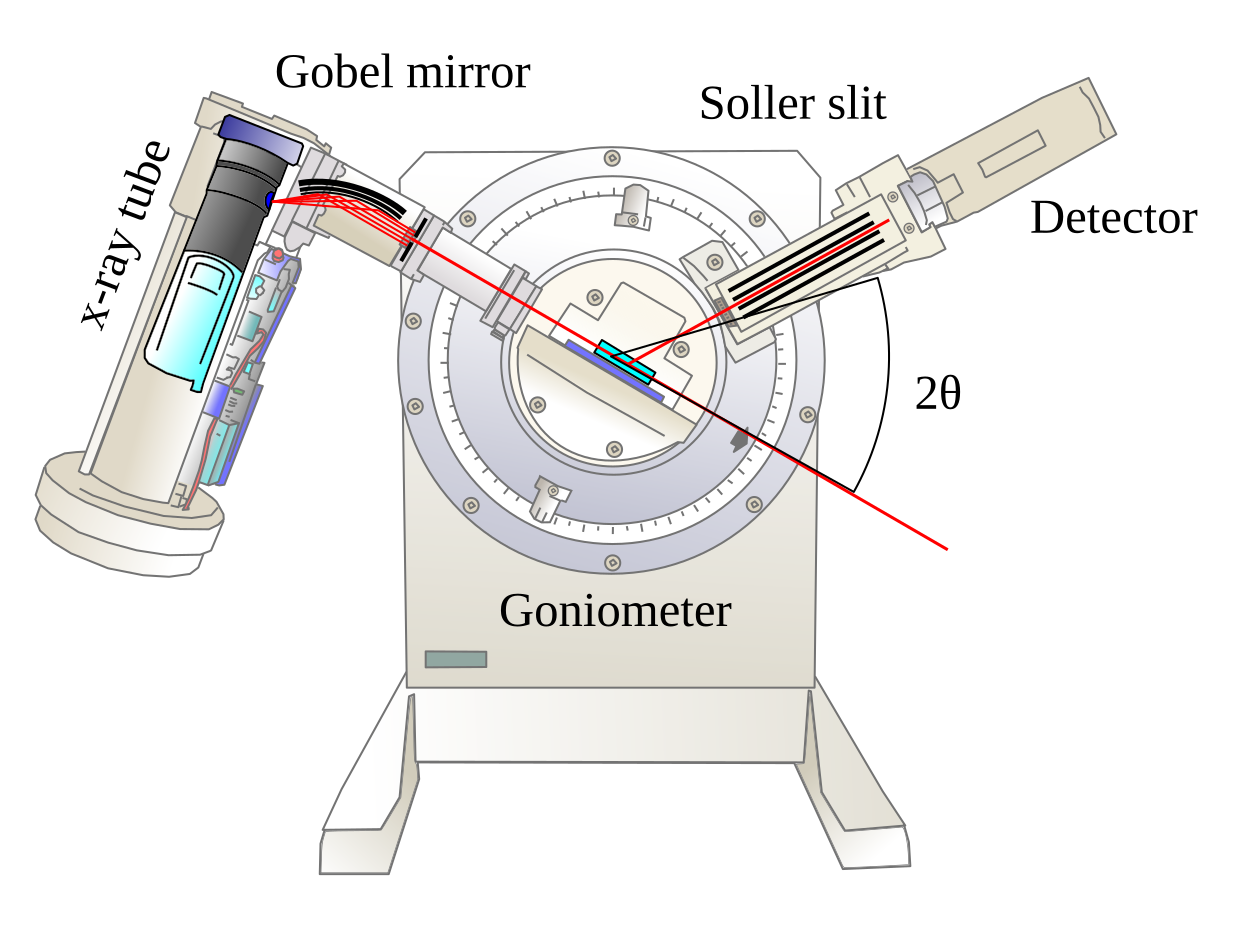
Bragg's equation (Equation 1) relates the wavelength of t1he X-rays to the angle of diffraction and the spacing between atomic planes in the crystal:
$$ \begin{equation} n \lambda = 2d_{hkl} \sin{\theta} \end{equation} $$
For crystal structure with cubic symmetry, the interplanar spacing $d$ is related to the unit cell parameter $a$ and the Miller indices by Equation 2:
$$ \begin{equation} d_{hkl} = \frac{a}{\sqrt{h^2+k^2+l^2}} \end{equation} $$
When running an XRD scan, you set the $\lambda$ to use, and the diffractogram shows at which $2\theta$ angles the peaks occur. A (simulated) diffractogram.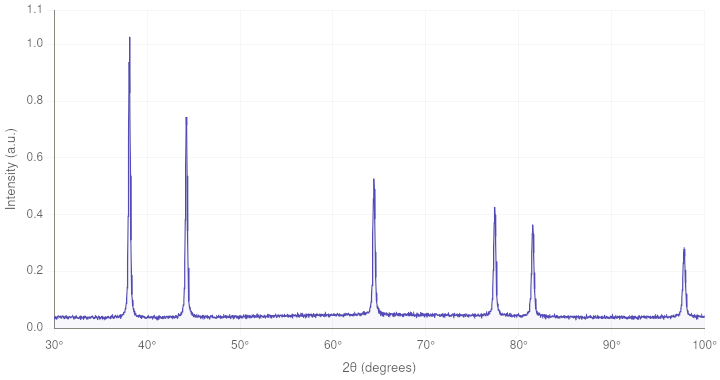
Guided example
As an example, assume that you investigate a single-phase metal alloy, at room temperature, with an X-ray wavelength $\lambda = 0.15418$ nm, with $30\text{°} \leq \theta \leq 100 \text{°}$. Assume a cubic unit cell (\autoref{eq:cubic-unit-cell} applies). The diffractogram shows peaks at these $2\theta$ angles (in degrees °):
- 38.09
- 44.22
- 64.41
- 77.41
- 81.50
- 97.79
From these, you want to calculate the cubic unit cell parameter $a$ and determine the type of packing (P, FCC, BCC).
To find $a$, reverse Equation 2:
$$ \begin{equation} a = d \cdot \sqrt{h^2+k^2+l^2} \end{equation} $$
Both the interplanar spacing $d$ and the factor $N = h^2+k^2+l^2$ are needed. Obtaining the former is straightforward: reverse Equation 1:
$$ \begin{equation} d = \frac{\lambda}{2 \sin{\theta}} \end{equation} $$
Finding the Miller indices requires more steps.
First compute $\sin^2{\theta}$ for each peak, and examine their ratio to the smallest value.
$$ \begin{align*} 2d \sin{\theta} &= n \lambda \\ \sin{\theta} &= \frac{n\lambda}{2d} \\ \sin^2{\theta} &= \frac{(n\lambda)^2}{4d^2} \\ \end{align*} $$
You know fom \autoref{eq:cubic-unit-cell} that $\frac{1}{d^2} = \frac{h^2+k^2+l^2}{a^2}$; substitute this in:
$$ \begin{equation} \sin^2{\theta} = \frac{(n\lambda)^2}{4a^2} \cdot (h^2+k^2+l^2) \end{equation} $$
Equation 5 shows that $\sin^2{\theta} \propto N$ (direct proportionality), with a proportionality constant of $C =\frac{(n\lambda)^2}{4a^2}$ which is the same for all peaks in the diffractogram, and depends only on $\lambda$ and $a$. In other words, $\sin^2{\theta}$ encodes $N$, which in turn encodes the Miller indices, which are needed to compute the unit cell parameter $a$.
Since $a$ is not known yet, you can't yet compute $N$. This is why you take the ratio of each $\sin^2{\theta}$ to the smallest of all the values:
$$ \begin{align*} \sin^2{\theta}_i &= \frac{(n\lambda)^2}{4a^2} \cdot (h^2 + k^2 + l^2) = C \cdot N_i \\ \frac{\sin^2{\theta}_i}{\sin^2{\theta}_1} &= \frac{\cancel{C}N_i}{\cancel{C}N_1} = \frac{N_i}{N_1} \end{align*} $$
This produces a list of ratios $\frac{N_i}{N_1}$ where the constant $C$ cancels out. Now the objective is to recover the $N_i$. All $N_i$ are positive integers, because they are sum of squares of integers. Therefore, finding the smallest integer that, when multiplied with $\frac{N_i}{N_1}$, returns all integers, is equivalent to finding $N_1$. You can find this by brute force: you multiply all the ratios by 1, then by 2, then by 3, and so on until \textit{all} the results are integers. In this example, multiplying all the ratios by 3 produces integers.
| # | $2\theta\ (^\circ)$ | $\sin^2\theta$ | ratio / min | $N = h^2+k^2+l^2$ | hkl | $d\ (\mathrm{nm})$ | $a\ (\mathrm{nm})$ |
|---|---|---|---|---|---|---|---|
| 1 | 38.09 | 0.10648 | 1.000 | 3 | 111 | 0.23625 | 0.40919 |
| 2 | 44.22 | 0.14167 | 1.330 | 4 | 200 | 0.20482 | 0.40963 |
| 3 | 64.41 | 0.28404 | 2.668 | 8 | 220 | 0.14465 | 0.40913 |
| 4 | 77.41 | 0.39101 | 3.672 | 11 | 311 | 0.12328 | 0.40888 |
| 5 | 81.50 | 0.42610 | 4.002 | 12 | 222 | 0.11810 | 0.40911 |
| 6 | 97.79 | 0.56777 | 5.332 | 16 | 400 | 0.10231 | 0.40923 |
These integers are the $N_i$ values; they are defined as $N = h^2+k^2+l^2$. To find $h$, $k$, and $l$, the question is "How can this positive integer be expressed as the sum of three squares of integers?"
The table below collects the possibilities for $1 \leq N \leq 20$.
| $n$ | $hkl$ |
|---|---|
| 1 | 100 |
| 2 | 110 |
| 3 | 111 |
| 4 | 200 |
| 5 | 210 |
| 6 | 211 |
| 7 | N/A |
| 8 | 220 |
| 9 | 300, 221 |
| 10 | 310 |
| $n$ | $hkl$ |
| 11 | 311 |
| 12 | 222 |
| 13 | 320 |
| 14 | 321 |
| 15 | N/A |
| 16 | 400 |
| 17 | 410, 322 |
| 18 | 411 |
| 19 | 331 |
| 20 | 420 |
The $hkl$ values for $n = h^2+k^2+l^2$ for $1 \leq n \leq 20$.
From the Miller indices, an $a$ value can be computed for each angle at which the diffractogram shows a peak; ideally, these all yield the same $a$ value; in reality, an error analysis should be performed.